
Fellow CMOTHR.
This is a topic that is difficult and honestly demands a lot of energy to digest. We are, all of us, card-carrying members of the human race. CMOTHR. That’s the only membership that matters here. We deserve compassion for the difficult attempt to live meaningfully enough in this strange time we are living in. But we can’t talk honestly about humans without talking about our capacity for cruelty. This topic matters because it’s a part of us. So buckle up with your favorite food and beverage — this is going to be a hard one.
Right now, one of the most disturbing stories circulating is the so-called “sniper safari” — wealthy foreigners allegedly paying to shoot at civilians from sniper positions during the siege of Sarajevo. Maybe it’s true. Maybe it isn’t. But here’s what matters: we don’t immediately dismiss it as impossible. That hesitation, that dark recognition, is the starting point of this text. Because somewhere inside us, we know what humans are capable of. And that knowledge implicates us all.
The same species
The Holocaust. Rwanda. Cambodia. Bosnia. Darfur. ISIS and the Yazidis.
These atrocities were not committed by a separate species of monsters. They were committed by humans — people with families, memories, humor, fear, ambition. People built from the same biological architecture as you and me.
And then there is the quieter violence. The partner who, over years, dismantles another person’s world piece by piece — their money, their friendships, their sense of what is real — until leaving feels impossible. The child who receives an encrypted message on a phone, takes something to stop himself from overthinking, and goes. The executive who buried the research showing his product was killing people, and went home to his family that evening.
None of them arrived at cruelty by accident. None of them are from another planet.
This is the thought we must sit with: the capacity for profound cruelty is not an aberration. It exists within the human condition.
But acknowledging that capacity is not the same as excusing it.
Understanding is not absolving
To say that evil behavior is human behavior is not to deny responsibility. Responsibility does not disappear when behavior becomes understandable.
Some humans do not merely fail — some humans choose, cultivate, and defend cruelty. They design it. They organize it. They justify it. Those choices remain fully theirs.
Understanding how humans arrive at evil is not about distributing forgiveness. It is about refusing the comforting lie that evil only belongs to others.
Evil does not appear from nowhere. It is built. In every large-scale atrocity, in every household where fear has become a permanent climate, in every chain that turns a child into a weapon — the same roles appear. Architects who design, legitimize, and organize harm. Agents who willingly carry it out. Bystanders who adapt, comply, or remain silent while it unfolds.
These roles are not morally equal. But they are all human. And the question worth asking is not just who fills each role — but what conditions make each role more or less likely.
The second
It doesn’t arrive with ideology or planning. It arrives in an ordinary moment — a queue, a look that landed wrong, a person who feels cornered. And then, in under thirty seconds, the moment tips.
Most violence doesn’t announce itself.
Research consistently shows that around three quarters of homicides are not calculated. They are eruptions — from humiliation, from fear, from a nervous system that has stopped calculating tomorrow and collapsed entirely into right now.
In that state, a person is not weighing consequences. The part of the mind that considers the future goes quiet. The part that says I will not survive this humiliation gets very loud. Stress hormones rise. Tribal shortcuts take over. The future disappears and there are only the next five seconds.
This is why longer prison sentences don’t stop most violence. The person in that moment is not reading the law. They are not performing a rational calculation. They are inside a biological state that makes tomorrow feel like a fiction.
What interrupts violence in that state is not the threat of future punishment. It is friction. Time. A person who steps in. A space that feels different enough to create a pause. A moment of interruption long enough for the future to exist again.
We know this. And yet we keep building systems that assume the opposite.
The paradox of safety
Human cruelty tends to flourish at two opposite ends of the same spectrum.
At one extreme: impunity. Consider Jeffrey Epstein. Money doesn’t create evil — it removes friction. With enough wealth, you can buy distance from consequences, surround yourself with people who never say no, and gradually stop encountering other humans as people whose refusal means anything. They become background. Resources. Props.
This doesn’t require a monster. It requires insulation — from consequences, from dissent, from the ordinary friction that reminds us that other people are real. And it requires a circle. A group of people with similar access, similar insulation, and a shared identity built around the tacit understanding that normal rules do not apply here. No one in that circle says this has gone too far — because saying so would cost them their place in it.
The sniper safari, if it happened, follows the same logic. Wealth sufficient to purchase access. Distance sufficient to make the targets feel unreal. A system willing to provide the experience. And almost certainly, a social world in which it was possible to discuss — or at least not impossible to imagine.
This is not rare psychology. It is ordinary psychology with the friction removed.
At the other extreme: fear. When survival is uncertain, identity hardens into a weapon. Humiliation becomes combustible. Scapegoats stop being an option and become a psychological necessity. For someone drowning in fear, destroying an enemy feels like the only way to stay afloat.
The system connects these poles. The powerful don’t just benefit from the desperation of others — sometimes they manufacture it. Tobacco manufactured doubt. Oil manufactured delay. The attention economy manufactures outrage and loneliness on demand. Some criminal networks deliberately construct conditions where a young person cannot think clearly enough to say no.
Rationality is expensive. When safety is present — food, warmth, dignity — we can afford nuance, doubt, and empathy. Under threat, the system shifts into economy mode. A society that engineers insecurity does not just cause suffering — it erodes the population’s capacity to resist manipulation.
This is not stupidity. It is strategy.
The manufactured second
There is a layer beneath the spontaneous moment of violence.
Some humans study what makes that moment available in another person. They learn which combinations — of debt, belonging, humiliation, trauma, and manufactured reward — make someone unable to choose otherwise. And then they construct those combinations deliberately.
Drugs to dissolve hesitation. Systems designed to make violence feel like completing a task. Recruitment that looks like an invitation to belong. Economic traps that foreclose every other option. People who orchestrate harm from a great distance and never touch a weapon themselves.
And shame. Always shame. Shame is not a side effect of these systems — it is a load-bearing wall. The architect of cruelty knows that if refusal costs you your identity, your belonging, your sense of being someone at all, then refusal becomes almost impossible. Shame ensures the silence. Shame keeps the system closed.
The person who cannot think clearly in that second — who has been recruited, indebted, isolated, numbed — bears one kind of responsibility.
The person who engineered that inability to think bears another. And that responsibility does not diminish because the mechanism is sophisticated, or the distance is great, or the profits flow through legitimate systems.
The same logic applies to the partner who systematically dismantles another person’s world over years — not in a moment of lost control, but by design, piece by piece, until the other person no longer knows what they are allowed to feel. Shame is the mortar in that construction too. You stayed. You knew. Who would believe you now.
Architecture is architecture, whether it produces a building or a trap.
The weight of agency
Moral agency is real. But it is not evenly distributed.
The ability to say no depends on more than character. It depends on conditions. Resistance requires psychological stability, social backing, some margin of safety, and a belief that refusal will not cost you everything.
Where punishment is severe, where collective protection is absent, where fear is constant — silence is often not consent. It is survival. This does not make silence innocent, but it makes it situated.
Silence stabilizes power. It allows violence to continue. But silence is rarely chosen in a vacuum. When punishment is severe, collective protection is absent, and fear is constant, the cost of resistance exceeds many people’s capacity to bear it. There have always been those who resisted. Their existence proves resistance is possible — not that it is universally available. Moral courage is real, but it grows in soil: community, meaning, protection, shared risk. It does not arise equally everywhere.
A society that engineers insecurity — through inequality, through isolation, through systems that extract dignity as a business model — does not just cause suffering. It erodes the capacity of ordinary people to do the right thing when it matters.
Safety is not softness. It is the condition under which humans can afford to be their better selves.
Those who cannot be reached — and those who try
Some individuals are harder to reach than others. The door to connection seems locked from the inside. The hand extended meets nothing. Professionals try, exhaust themselves, and eventually step back — not from cruelty, but from depletion.
But hard to reach is not the same as impossible. It means the work is slower, requires more skill, more patience, more resources. It means families need support — not blame. It means specialists need training, time, and institutional backing.
What happens instead? A mother calls emergency services about her son. She is relieved when he receives compulsory care. He is released the next day. A week later, he kills someone. A young person shows early signs — disturbing behavior, social alienation, fixation on violence. The system responds with waiting lists, underfunded clinics, and case files closed too soon.
Society tells parents: your child reflects your parenting. So when something is wrong — deeply, frighteningly wrong — the parent hesitates. They feel shame before they feel entitled to help. And when they finally reach out, the help is not there. This is manufactured isolation. The same shame that keeps victims silent in abusive relationships keeps families from asking for help before it is too late.
We know what works. Early contact. Long-term relationships with the same professionals. Schools that collaborate instead of exclude. Support for families — tools, not blame. Specialized care before the first crime, not after.
We call it too expensive. Then we pay the other price.
And here is what the research keeps showing, quietly and without drama: when a child grows up feeling safe enough — physically safe, emotionally seen, connected to people who will not abandon them — they are far less available for recruitment into cruelty. Not because they are better people. Because they have enough ground under their feet to make a choice.
Safety is not just a feeling. It is a structural condition. And building it is a moral act.
Fallible, not equivalent
We are all capable of failure. We are not all equivalent.
To acknowledge shared human vulnerability is not to flatten moral difference. It is to explain how entire societies can drift — while still holding architects and enthusiasts fully accountable. Some people build hell deliberately. They are not fumbling. They are convinced. They have run the numbers.
Blame without understanding leads to denial. Understanding without responsibility leads to passivity. CMOTHR demands both.
We acknowledge the mechanics. We refuse the absolution. We recognize that our capacity for responsibility is shaped by conditions — and that changing those conditions is itself a moral act.
Why the asterisk matters
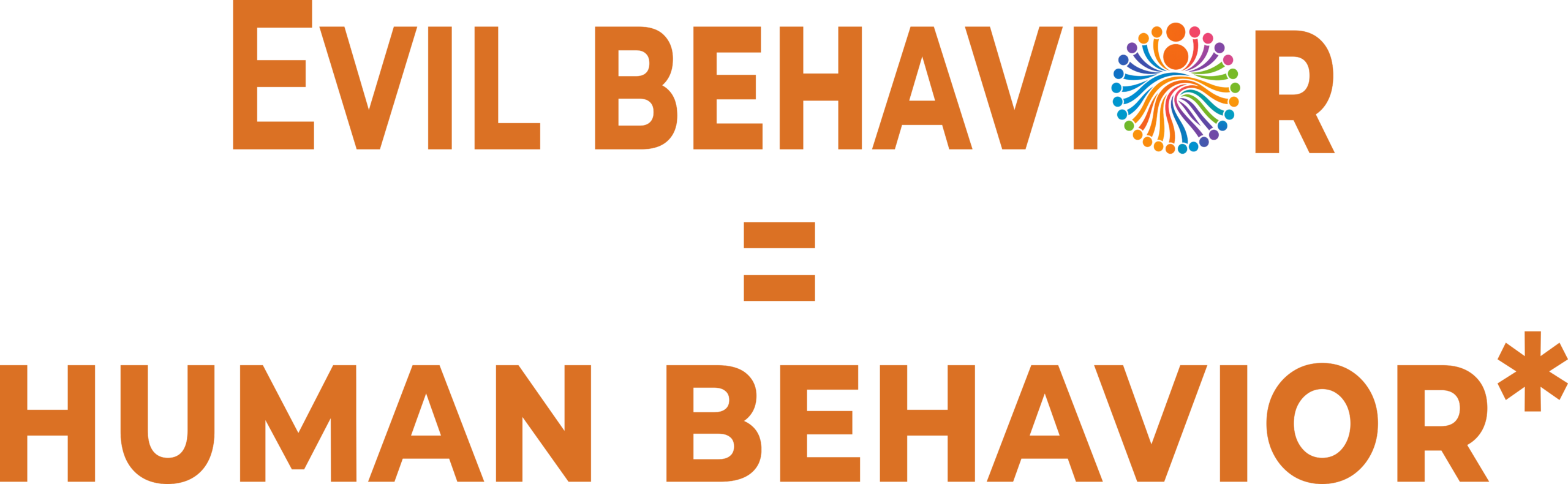
Evil behavior = human behavior*
*Under certain conditions — conditions we have the power to change.
The task is not to hunt monsters. It is to build a world where fewer humans are pushed toward becoming them — and where those who choose cruelty are stopped early, decisively, and without illusion.
It is to interrupt the second. To reach the child before the network does. To support the family before the shame silences them. To build spaces where the future exists long enough for people to choose it.
This is not innocence. It is shared fragility — and shared responsibility.
We end where we began: if you had unlimited money, no consequences, and a world that prioritized your comfort over others’ lives — who would you become?
The uncertainty is the point.
But so is this: right now, somewhere, someone is building the conditions that will answer that question for someone else. Without their knowledge. Without their consent.
And somewhere else, someone is interrupting those conditions. Quietly. Without recognition. Because they decided that the second before the worst happens is worth fighting for.
That person is also a fellow CMOTHR.
— A Fellow CMOTHR